


The Architecture of Livable Systems

Updated: May 21
Art Must Support Life — Or It Fails
By Erik Kling
Part of an ongoing architectural doctrine on energy, perception, and the invisible structures shaping human experience.Across all domains, invisible structures ultimately determine visible outcomes.
There is a question rarely asked in contemporary art.
Not simply:
What does the work express?
Or:
What does it represent?
But rather:
What does it do to a human being over time?
I have experienced environments where the presence of art created tension instead of clarity.
Spaces where the visual field remained dense, unresolved, and overwhelming. Where the eye had no place to rest. Where the environment remained psychologically active long after entering it.
The result was simple:
The space could not support rest.
This reveals something fundamental.
Art is not neutral.
Art is environmental architecture.
This idea is older than contemporary art itself.
In ancient Greece, philosophy was never separated from the question of how humans should live. Architecture, proportion, harmony, public space, and beauty were understood as components of civilization itself—not decorative afterthoughts.
For Aristotle, the purpose of civilization was never merely efficiency, expansion, or power.
It was eudaimonia:
This principle shaped not only ethics and politics, but also the environments civilizations created around themselves.
The spaces humans inhabit ultimately shape the quality of human experience within them.
Later, architectural theory commonly distilled Vitruvius' ideas into the enduring principles of:
strength
utility
beauty
Architecture, in this view, was never intended to be merely decorative. It was meant to support durable and coherent human life over time.
Centuries later, Renaissance thinkers such as Leonardo da Vinci continued searching for harmony between the human body, geometry, proportion, and environment.
Even Byzantine architecture understood this intuitively.
Its spaces were never merely decorative.
Light, rhythm, symmetry, scale, acoustics, and atmosphere were carefully orchestrated to influence contemplation, orientation, perception, and psychological coherence.
The environment itself became part of human experience.
And yet much of the contemporary art world still operates on an increasingly fragmented model.
Art is treated as:
an object
a statement
a collectible
Placed into space almost as an afterthought.
But a human being does not experience art as an isolated object.
A human experiences a field.
And this field determines:
whether the mind settles or remains activated
whether the body relaxes or resists
whether the space supports life—or drains it
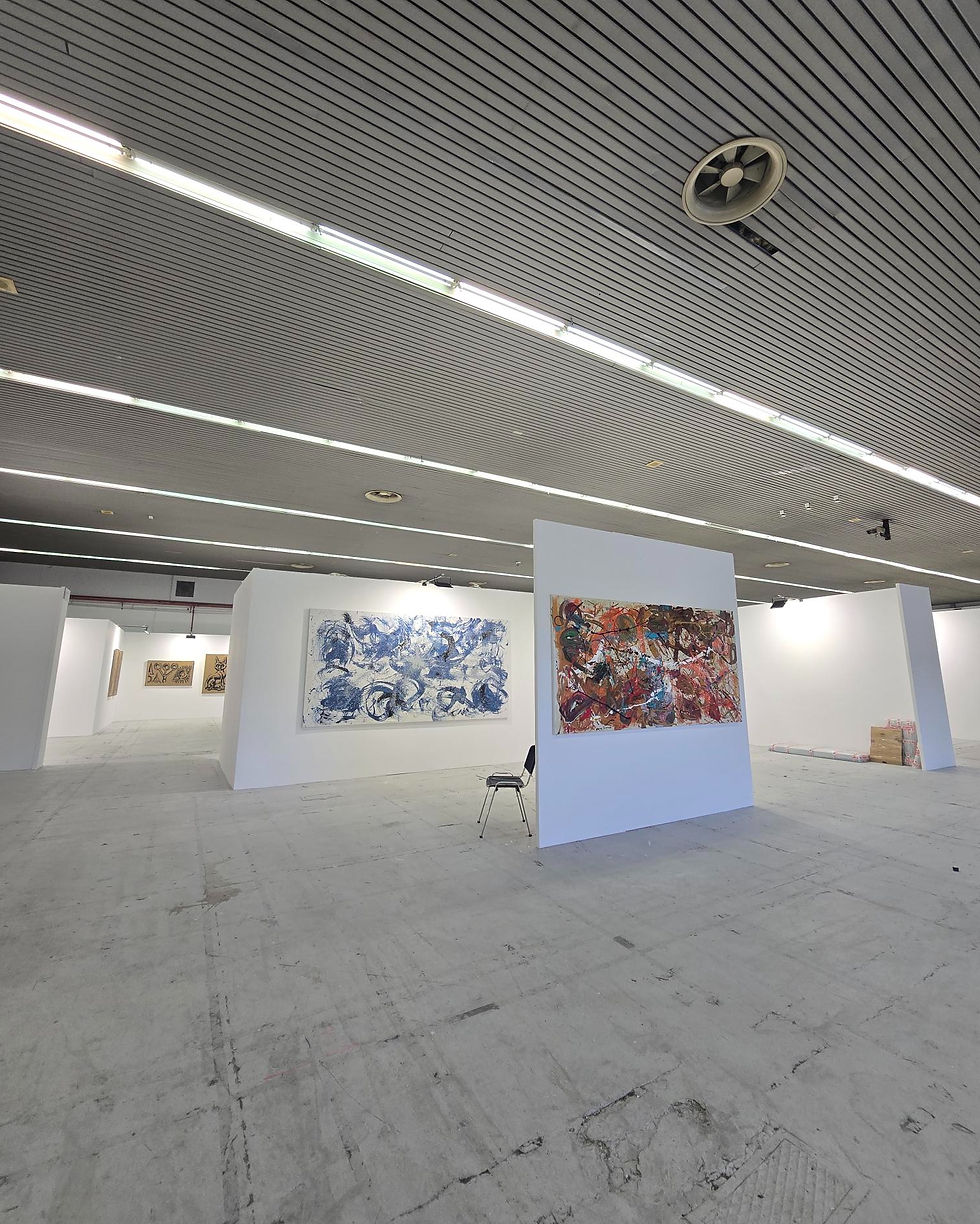
During the Thessaloniki Art Fair, I experienced something that clarified this principle with unusual precision.
For the first time in a long time, my work was given space.
Not simply wall space.
Breathing room.
Distance.
Light.
Context.
The viewer could step back. The eye could settle. The work could interact with architecture instead of competing against visual compression.
The difference was immediate.
People remained longer.
Conversations became calmer.
The work revealed relationships between scale, distance, color tension, and negative space that disappear when environments become overcrowded, fragmented, or economically compressed.
This realization extended far beyond my own work.
Over several days, I spoke with artists, galleries, curators, and art historians.
Beneath very different artistic languages, a shared reality appeared:
Everyone is searching for meaningful visibility.
Not only exposure.
Context.
The experience also revealed something larger.
Artists are not the only ones under pressure.
Galleries themselves are searching for sustainability.
Platforms compress visibility.
Attention fragments.
Space becomes increasingly transactional.
And yet art does not function transactionally.
Art functions environmentally.
Its meaning changes completely depending on:
placement
light
rhythm
distance
surrounding works
architecture
the emotional condition of the space itself
This is why the future of meaningful art cannot depend on exposure alone.
It requires livable systems capable of preserving contextual dignity.
Systems that support not only visibility—but coherence, sustainability, breathing room, and long-term human experience over time.
The Missing Criteria
There is still no widely accepted standard for what art should contribute to a space over time.
And yet there should be.
Because environments shape:
behavior
clarity
emotional stability
attention
decision quality
human energy
Stoic philosophy understood this deeply.
Marcus Aurelius repeatedly emphasized the importance of internal coherence, restraint, clarity, and alignment between the individual and the surrounding world.
Human beings cannot remain internally coherent while permanently surrounded by fragmentation, excess, instability, and unresolved psychological noise.
The environment always participates in shaping the human condition.
This is not only philosophical.
It is architectural.
A Different Standard
Art must be evaluated not only by concept or history—but also by its environmental impact.
A complete work contributes to:
Stability
The space holds. It does not collapse inward.
Balance
Forces exist in relationship, not conflict.
Energy Coherence
The visual field aligns instead of fragmenting attention.
Spatial Control
The work organizes the environment—not the other way around.
Long-Term Livability
The space remains sustainable over time—not exhausting.
If these are missing, something remains incomplete.
Beyond Expression
Expression alone is not enough. Intensity alone is not enough. Even meaning alone is not enough.
Because a space must do more than communicate.
It must support life.
This does not mean all art must soothe, comfort, or avoid tension.
Some of the most important works in human history are intentionally destabilizing.
Goya, Francis Bacon, and much of modern expressionism confront violence, fragmentation, mortality, and psychological rupture directly.
Their importance lies precisely in their capacity to reveal truths humans would otherwise avoid.
But there remains a distinction between art that confronts the human condition and environments designed for continuous human inhabitation over time.
The question of livability emerges not only at the level of individual works, but at the level of sustained environmental systems.
From Socrates onward, Greek philosophy kept returning to the same underlying question:
What conditions allow a human being to live well?
That question remains unresolved in much of contemporary culture.
Today, many environments optimize for stimulation, novelty, speed, visibility, and commercial attention.
Very few optimize for long-term human flourishing.
The Shift
The question is no longer:
"Do I like this artwork?"
The more important question is:
"Can I live with this environment?"
A New Category
There is a missing category between art and architecture.
A category that does not treat works as isolated objects, but as active components of an environment.
I define this as:
Art as the Architecture of Livable Systems
A livable system is not only visually engaging. It is structurally supportive over time.
It allows the human system to:
settle
think
rest
operate with clarity
Much of contemporary art optimizes for concept and expression.
My work increasingly operates at the level of environment and human experience over time.
Completion
A work is not complete when it is finished.
A work is complete when the environment surrounding it becomes coherent enough for the work, the space, and the human within it to coexist over time.
The Thessaloniki experience reinforced something I can no longer ignore:
Art does not survive through visibility alone.
It survives through architecture.
Through systems that preserve meaning, context, breathing room, and dignity—for artists, galleries, and the environments people must actually live within.
Art must support life.
Or it fails.
Not every environment deserves to endure.
Only the ones capable of sustaining human clarity over time.
Intellectual Context and Historical Grounding
This essay builds on a long philosophical, architectural, and civilizational lineage exploring the relationship between human beings, environments, coherence, and flourishing over time.
Rather than treating art as an isolated object, this framework approaches art as part of a broader environmental and human system.
Aristotle — Nicomachean Ethics
Aristotle argued that the purpose of civilization was not merely power, expansion, or efficiency, but eudaimonia — human flourishing. This essay extends that principle into the environmental realm: the spaces humans inhabit participate directly in shaping the quality of human experience.
Vitruvius — De Architectura
Later architectural theory commonly distilled Vitruvius' ideas into the enduring principles of strength, utility, and beauty. Architecture, in this view, was never intended to be merely decorative, but to support coherent and sustainable human life.
Leonardo da Vinci — Human Proportion and Harmony
Leonardo's Vitruvian studies connected the human body, geometry, architecture, and natural systems. His work reflected the belief that harmony within environments mirrors harmony within the individual.
Byzantine Architecture — Environment as Consciousness
Byzantine architecture used light, symmetry, rhythm, scale, and atmosphere not merely for decoration, but to shape perception, contemplation, orientation, and psychological coherence.
Marcus Aurelius — Stoic Coherence
The Stoic influence within this essay relates to principles of internal order, restraint, clarity, and alignment between human beings and their environments. The closing statement of this essay is an original synthesis influenced by Stoic thought rather than a direct quotation.
Socrates — The Question of How to Live
The essay's central question — "What does this do to a human being over time?" — follows the Socratic tradition of examining the conditions necessary for a meaningful and coherent life.
Contemporary Environmental Psychology and Living Systems
Modern discussions around environmental psychology, regenerative architecture, human-centered design, and living systems theory increasingly recognize that environments influence cognition, stress, emotional regulation, social interaction, and long-term human well-being.
Connection to Human-Aligned Systems Architecture
This essay forms part of a broader doctrine exploring the relationship between systems, infrastructure, culture, humanity, energy, perception, and long-term livability.
Across all domains, the principle remains consistent:
Invisible structures shape visible outcomes.
Erik Kling
Architecture determines optionality. Optionality determines leverage. Leverage determines control.
Explore: Axisync Partners — AXYNAO — Erik Kling Art


Comments