


Placement Is Part of the Work

Updated: Aug 7
Where Art Lives Can Shape What Art Becomes

Acrylic Enamel by Erik Kling, envisioned within a contemporary meditation and reflection space. The placement explores how color, scale, natural materials, light and architecture can transform the way an artwork is experienced — and how the artwork, in turn, can change the emotional character of a space.
For a long time, I thought of the completion of a painting as a fairly clear moment. There comes a point when another brushstroke would no longer improve the work, when the composition has found its balance and when the artist has to stop intervening. The painting is finished, it leaves the studio, and whatever happens afterward belongs to galleries, collectors, curators or whoever eventually lives with it.
My own experience has made that distinction much less clear.
I have created works without knowing exactly where they would eventually live, but I have also taken on work for which the intended placement was known before I began painting. In those cases, I entered the studio with the architecture already somewhere in my mind. I knew the proportions of the environment, something about the wall, the surrounding materials, the light and, most importantly, how people would encounter the work.
The architecture did not dictate the painting. I would not want it to. A work still has to find its own internal logic and become something more than an answer to a design brief. But knowing the eventual environment changed the creative process in subtle ways. Scale meant something different. Color existed in relation to something beyond the edges of the work. The energy of the composition had to be considered not only internally, but also in relation to the room it would eventually inhabit.
And I loved creating those works.
There was something deeply satisfying about knowing that I was not simply creating an isolated object and then searching for a home for it afterward. I was creating a work that would eventually participate in a particular human environment.
That experience gave me something more convincing than a theory about placement. It showed me directly that placement can influence a work even before the work exists.
The reverse is equally interesting. I have also watched finished paintings acquire very different qualities when considered within different architectural environments. A work can appear intimate in one space and monumental in another. It can become contemplative, energetic, grounding or disruptive depending on the architecture surrounding it.
In one case, the architecture precedes the artwork and becomes part of the conditions under which it is created. In the other, the artwork comes first and architecture changes the conditions through which it is experienced.
Both experiences have led me to the same conclusion:
Placement is part of the work.
The artwork does not end at its physical boundary
A painting may physically stop at the edge of its surface, but our experience of it does not.
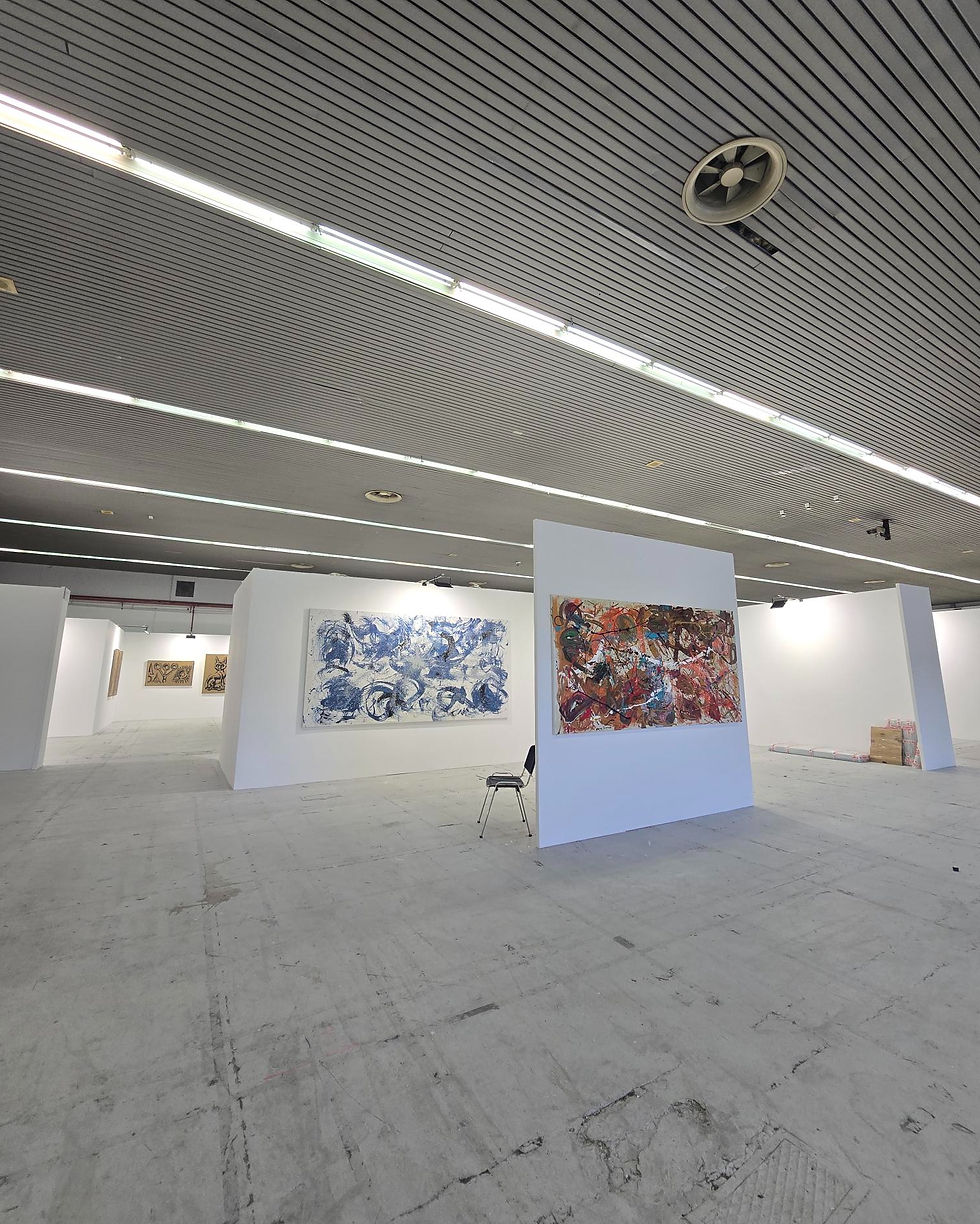
The moment a work enters a room, it begins interacting with everything around it. Light reaches the surface from a particular direction. The dimensions of the wall alter our perception of scale. Materials surrounding the work either reinforce or contrast with its texture. The distance from which people first encounter it determines what they see before they ever notice the details.
Even the purpose of the building matters.
A painting seen in a museum is not experienced in exactly the same way as the same painting in a private home. A work in a meditation space does something different from that same work in a hotel lobby. A painting encountered while walking through a university library enters consciousness differently from one discovered at the end of a hospital corridor.
The physical artwork may remain unchanged, but the system around it has changed. And because art ultimately exists through perception and human encounter, those conditions matter.
For much of modern art history, we have become accustomed to thinking of an artwork as an autonomous object. The artist creates it. The gallery presents it. The collector acquires it. Architecture appears afterward, almost as a practical question: where should we hang it?
There is nothing inherently wrong with that sequence. Many extraordinary works begin without any knowledge of where they will eventually live.
But I have become increasingly interested in a different question.
Instead of asking only, “Where does this work fit?”, what happens if we ask, “What happens to this place when this particular work enters it?”
That change in the question changes almost everything.
Architecture changes the encounter
Imagine a large abstract painting dominated by deep red.
Place it against a white wall in a museum and the neutrality of the surrounding space may intensify the color. The work becomes an object of concentrated attention. We approach it intentionally because the architecture has already told us that looking is the purpose of the room.
Move the same painting into a residential environment surrounded by warm wood, fabric and the rhythms of daily life, and the red may feel less monumental and more intimate.
Place it inside a quiet reflection space with filtered daylight, stone and natural materials and the same color may acquire yet another quality. It may suggest warmth, vitality or something bodily and grounding.
Nothing has been added to the painting. Nothing has been removed.
What changed was the relationship.
We do not perceive color independently of surrounding color. We do not perceive scale independently of surrounding scale. We do not experience silence independently of what preceded it. Human perception is relational, and art participates in that same system.
This is also why the traditional white cube is so powerful. It appears to remove context, but in reality it creates an extraordinarily deliberate one. The neutral wall, controlled lighting, visual separation and quietness are architectural decisions designed to concentrate attention on the artwork.
The white cube is not the absence of architecture. It is architecture optimized for looking at art.
Outside the gallery, however, the possibilities become much broader.
I am increasingly interested in what happens when art enters the places in which human life actually unfolds: homes, hotels, hospitals, universities, workplaces, cultural institutions, public buildings and spaces for meditation or reflection.
In these environments, the artwork may not receive the concentrated attention it would receive in a gallery. But it can acquire something else: continuity.
Someone may pass it every morning for ten years. A visitor may encounter it during an important moment in life. A child may remember a painting decades later without ever having known the artist's name. Morning light may reveal one aspect of a work and evening light another. Memory begins to accumulate around it.
At that point, the painting is no longer simply occupying a wall. It has become part of the lived architecture of the place.
From decoration to relationship
There is an enormous difference between filling an empty wall and placing a work of art.
The first question is usually practical: what would look good here?
The more interesting question is relational: what kind of experience should exist here, and what work could contribute to it?
That does not mean that art should always make an environment calmer or more pleasant. Art is not merely an instrument for comfort. Some work should provoke. Some should create tension. Some should interrupt the expectations established by the architecture around it. Other work may invite contemplation, curiosity, joy or stillness.
The important point is that these effects do not occur independently of the environment.
Scale matters. Light matters. Material matters. Circulation matters. Viewing distance matters. The purpose of the space matters. Most importantly, the people who will inhabit that space matter.
A highly detailed work that rewards close observation may lose much of its character if people can never approach it. A large energetic painting placed in a narrow corridor may overwhelm rather than activate the architecture. A work with significant surface texture may transform throughout the day as changing light moves across it.
And there is a third possibility, one I have experienced personally: the space can be known before the work is made.
In that situation, placement is no longer the final stage of the process. It becomes one of its original conditions.
The artist may know the scale of the wall, the character of the room or the emotional atmosphere of the environment before beginning. The challenge then is not simply to manufacture something that “matches.” It is to remain an artist while becoming conscious of the larger architecture the work will eventually enter.
I found that process surprisingly liberating.
The boundaries were not necessarily restrictions. They became another source of possibility.
From the studio into architecture
These questions have become increasingly tangible through my own work.
My first oil-on-enamel series is already being explored through AXYNAO's architectural placement work. Seeing those paintings move conceptually from the studio into very different environments changed the questions I began asking about them.
I started thinking less about the work as an isolated surface and more about what happens when its internal energy enters a larger spatial system.
How much space does the painting need around it? From what distance should someone first encounter it? Does the architecture intensify the movement within the work or compete with it? What happens when a highly energetic painting enters a quiet environment? Can a work alter the emotional balance of a room without dominating it?
These were not always questions I asked while making the original paintings. They emerged because the work began entering architecture.
That exploration has also influenced the way I think about my next body of work, The Architecture of Papyrus, which is now approaching completion.

Acrylic Enamel on papyrus by Erik Kling, envisioned within an architectural setting that connects the material’s ancient origins with contemporary abstraction. An early preview from the forthcoming Architecture of Papyrus series. Toth, God of Wisdom was painted below the Pyramids in Giza, Egypt.
Papyrus brings an entirely different material character into my studio.
Before anything is added to it, the surface already contains information. Its fibers are visible. Its irregularities remain present. It is fragile and persistent at the same time. It carries an association with writing, record, memory and humanity's long attempt to preserve thought beyond an individual lifetime.
That gives the material an almost architectural quality before the composition begins.
It also raises an interesting question when brought into contemporary environments. Much of contemporary architecture is defined by highly controlled materials: glass, steel, concrete, polished stone and precisely manufactured surfaces. Papyrus belongs to another material vocabulary. It is organic, irregular and visibly connected to the hand and to nature.
Placing those two worlds together can create a conversation across time.
The ancient does not need to become nostalgic, and the contemporary does not need to reject the past. The tension between them can make both more visible.
One of the works from The Architecture of Papyrus accompanies this essay as an early preview of the new series. The complete series will follow into its own architectural placement exploration through AXYNAO.
I like that sequence.
First, the work exists as a work of art.
Then we begin asking where it might live, how architecture might change its presence and what kind of human encounter it might create.
Placement as stewardship
There is also a responsibility embedded in all of this.
When art enters an architectural environment, particularly one inhabited by many people, placement begins influencing human experience. That does not mean every decision needs to become intellectualized or overly complicated. Some relationships between artwork and space are immediately intuitive.
But the responsibility remains.
A hospital affects people differently from a hotel. A school affects people differently from a corporate office. A private home carries different emotional expectations from a museum or a public building.
Art participates in those environments.
It can introduce warmth into a highly technical space, movement into a rigid one, complexity into an environment that has become too predictable or stillness into a place overwhelmed by visual noise. It can also challenge the architecture around it and prevent a space from becoming emotionally neutral.
Architecture establishes conditions.
Art can alter them.
That is one reason I have become increasingly reluctant to think of placement as an administrative activity that begins only after a work has been completed and sold.
Sometimes placement comes afterward.
Sometimes it comes first.
And sometimes the most interesting possibilities emerge when artwork and architecture are allowed to inform one another without either becoming subordinate to the other.
When is a work finished?
All of this has changed the way I think about the idea of a finished artwork.
There is still a moment when the physical creation has to stop. Artists have to recognize it. There is a point when another intervention would no longer deepen the work but begin to damage what has already emerged.
But perhaps that moment represents only the completion of one stage.
The work then leaves the studio and enters another architecture.
It acquires light, distance and surroundings. People begin encountering it. Someone may live with it for years. Time accumulates around it. Memories attach themselves to it. The architecture changes, the people change and sometimes even our understanding of the work changes.
The artist cannot control all of that, nor should we try.
But we can acknowledge that the life of an artwork extends beyond the moment when the brush is put down.
I have experienced this from both sides now. I have watched finished works acquire new meaning through the spaces in which they are placed, and I have created works while already carrying their eventual architecture with me into the studio.
Both experiences have convinced me of the same thing.
A painting does not exist only within its physical boundaries. It exists through relationships: between material and light, scale and space, architecture and perception, and ultimately between the work and the human beings who encounter it.
That is why I no longer see placement simply as something that happens after art.
Placement is part of the work.
Creation gives the work its form. Architecture gives it context. Human encounter gives it a continuing life.
Erik Kling
Stoic Reflection:
The artist controls the making, but never the entire life of the work. We can choose the material, make the mark, refine the composition and, sometimes, shape the place in which it will first be encountered. After that, the work belongs partly to light, architecture, time and the people who stand before it. The discipline of the artist is to give the work everything it requires — and then have the wisdom to let it live beyond us.


Comments